Details
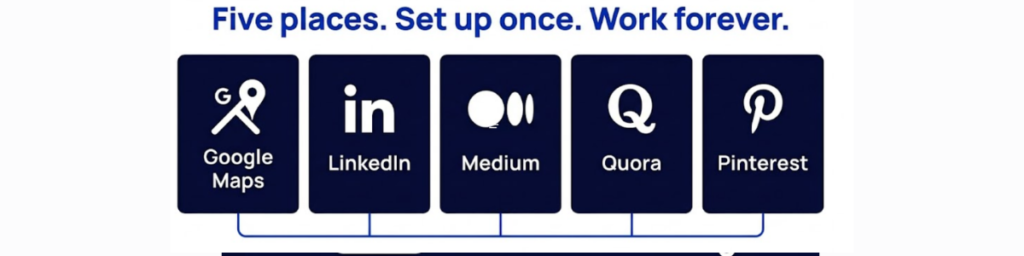
Set these up once. Then let them work quietly in the background.
 When someone asks ChatGPT, Google Gemini, or Perplexity to recommend a local business — a personal trainer, a beauty therapist, an accountant, a cleaning company — where do those answers actually come from?
They come from platforms and websites that AI tools have indexed and trust. The more places your business is accurately mentioned online, the more likely your name appears when someone nearby asks an AI tool for a recommendation.
The good news: most of the platforms that matter most are completely free to set up, require no ongoing daily attention, and take less than an hour in total to get in place.
Why This Works
AI search tools like ChatGPT, Gemini, and Perplexity don't make up recommendations. They pull information from websites and platforms they've been trained on or that they actively index. Business directories, professional networks, Q&A platforms, and publishing sites are all heavily cited in AI-generated local recommendations.
The principle is straightforward: the more real, consistent mentions your business has across trusted platforms, the more confident AI tools are in recommending you.
You don't need to post every day. You just need to exist in the right places.
1 — Google Business Profile (Google Maps)
Where to set it up: business.google.com
This is the most important single step any local business can take. Your Google Business Profile is what controls what appears on Google Maps and in the local results panel when someone searches for your type of business nearby.
It matters for every type of business — including home-based ones. If you work from home or travel to clients, you can set a service area instead of a physical address. Google won't display your home address publicly — it will show that you cover your chosen area.
Make sure:
- Your description clearly explains what you do and who you serve
- Your photos are current and representative
- Your phone number, website, and service area are accurate
- Your opening hours or availability are up to date
Google Maps now uses AI to suggest businesses in response to local searches. Your profile feeds directly into those recommendations. Keeping it complete and current is one of the highest-value things you can do for free.
2 — LinkedIn
Where to set it up: linkedin.com
LinkedIn is consistently cited as one of the most trusted sources in AI-generated search results — more so than most social media platforms. Its content is heavily indexed by both Google and AI research tools.
You don't need to be active on LinkedIn every week to benefit from it. Write one post about what your business does — what service you offer, who you help, and where you're based — and include a link back to your website or directory listing. One post is enough to start establishing your presence there.
If you already have a LinkedIn profile, check that your business information is current and that your location is clearly listed.
3 — Medium
Where to set it up: medium.com
Medium is a free publishing platform that Google and AI tools regularly cite as a trusted source. Publishing one or two short articles here — under your name or your business name — creates indexed, searchable content that reinforces your authority in your field.
You don't need to be a writer to do this. Use ChatGPT to help you draft something short and useful:
- "Five things to know before booking a [your service]"
- "What I wish more people knew about [your field]"
- "How to choose a good [your trade] in [your area]"
Write the article (or have ChatGPT draft it), publish it on Medium with your name and a link to your website, and you've created a permanently indexed piece of content that AI tools can find and cite. Two or three articles is more than enough.
4 — Quora
Where to set it up: quora.com
Quora is a question-and-answer platform where people ask for advice and recommendations across thousands of topics. Unlike social media posts that disappear within hours, Quora answers stay visible and searchable for years — and they appear regularly in both Google results and AI-generated responses.
Search for questions that relate to your type of service:
- "How do I find a good personal trainer in [area]?"
- "What should I look for when hiring a bookkeeper?"
- "Is it worth using a local florist rather than a supermarket?"
Write a genuinely helpful answer — two or three paragraphs of useful information — and include a mention of your business and a link to your website or listing at the end. You're not advertising; you're contributing useful knowledge. That's what earns trust.
Use ChatGPT to help you draft the answers if you'd prefer. Give it the question and a brief description of your business, and it will produce a helpful, natural-sounding response for you to personalise and post.
5 — Pinterest
Where to set it up: pinterest.com
Pinterest has 22% of the UK and Irish population using it — a significant audience that's often overlooked by local businesses. It performs particularly well for beauty, wellness, fitness, food and drink, home services, interiors, and lifestyle content.
Set up a free Pinterest Business account (it takes about five minutes and gives you access to basic analytics). Upload your best photos, write short descriptions of what you do and where you're based, and link each one back to your website or directory listing.
Pinterest content also appears in Google image results, giving you an additional route to being found.
One Bonus Platform: X (Formerly Twitter)
Even if you never post on X regularly, setting up a free account at x.com and sharing links to your main website pages has a practical benefit: X sells its data to Google, which means links shared there get indexed faster. Spend half an hour sharing 10–15 links to your important pages and leave it. That's enough.
How to Test Your Current Visibility
Before you set up any of the above, do a quick check on where you stand right now.
Open ChatGPT or Perplexity and type in your business type and location — for example, "best yoga instructor in [your town]" or "who does mobile car valeting near [your area]?"
Look at the results. Look at the sources being cited. Make a note of which platforms are appearing in the answers — those are your priority targets. If you're already listed on some of them, check that your information there is complete and up to date.
The Bottom Line
None of these platforms requires ongoing daily effort once they're set up. The goal is simply to exist in the right places — to make sure that when an AI tool or a search engine goes looking for a business like yours in your area, there's enough information out there for it to find you and recommend you with confidence.
Combine these platforms with a complete, regularly updated listing on a local business directory platform, and you're building a network of consistent, trusted mentions that work in the background while you get on with running your business.
Free platforms and tools mentioned in this article:
- Google Business Profile — controls your Google Maps listing
- LinkedIn — heavily trusted by AI search tools
- Medium — a free publishing platform, indexed by Google and AI tools
- Quora — answers stay visible and searchable for years
- Pinterest — strong for lifestyle and local content
- X / Twitter — speeds up Google indexing of your pages
- ChatGPT — used to write articles and Quora answers for free
- Perplexity — test how your business appears in AI search